
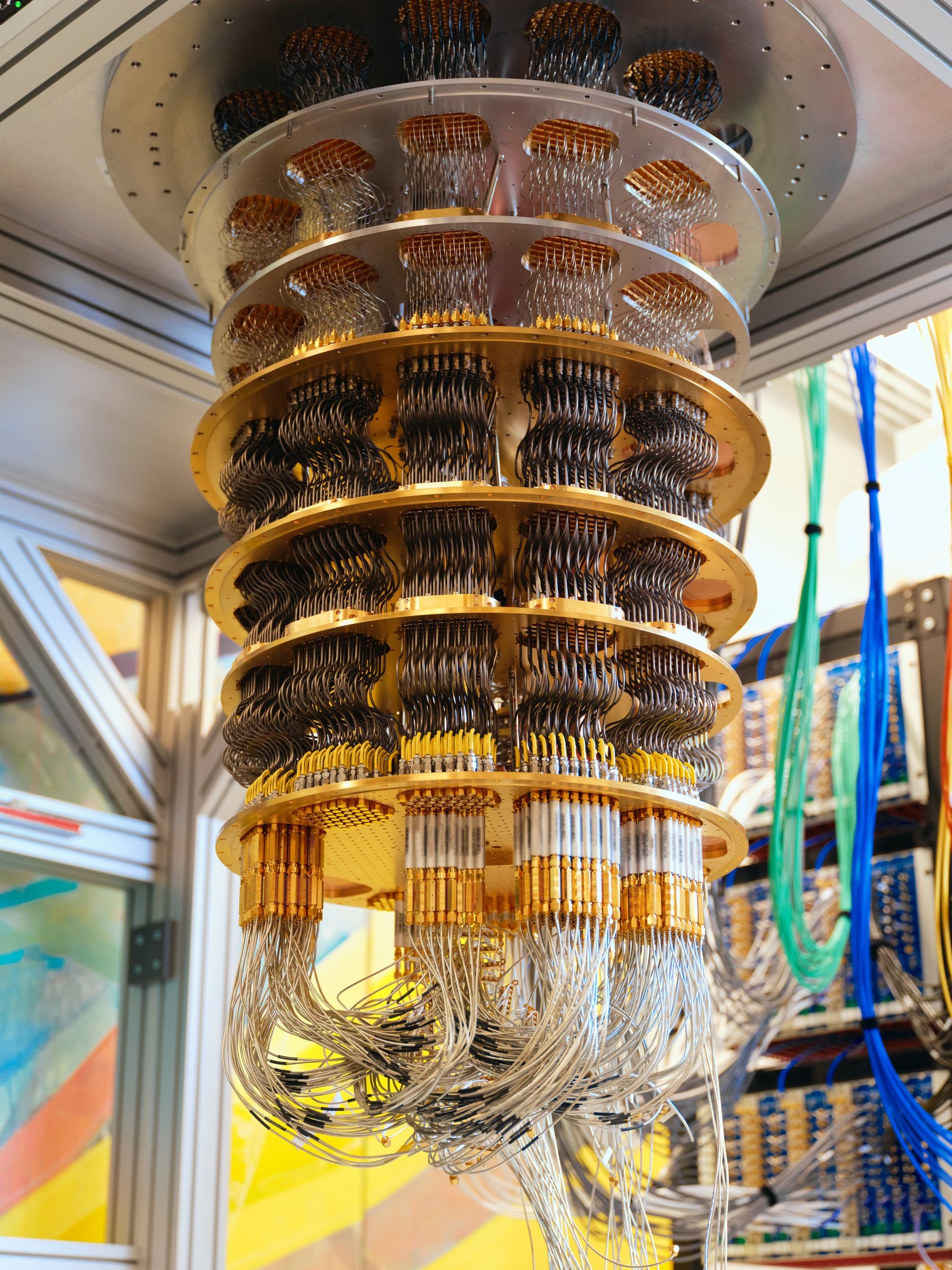
Google Quantum Chip
Google has once again pushed the boundaries of computational science with the introduction of its Willow quantum computing processor. This superconducting chip represents a significant stride towards realizing the dream of a fault-tolerant, large-scale quantum computer, promising to unlock solutions to problems currently intractable for even the most powerful classical machines.
Recently Google has claimed that its quantum processor Willow has achieved the first “verifiable” quantum advantage — a technological benchmark that means a quantum computer can outperform a classical one in practice and can be independently verified by other quantum systems, and the method can be repeated to generate the same result.
Features That Define Willow
The Willow chip is not merely an incremental upgrade; it boasts several groundbreaking features that set it apart:
105 Superconducting Transmon Qubits: At its heart, Willow utilizes 105 transmon qubits. These are a type of superconducting circuit designed to behave as artificial atoms, capable of existing in a superposition of states (both 0 and 1 simultaneously) and becoming entangled with each other. The sheer number of high-quality qubits is a testament to Google’s engineering prowess, moving closer to the scale needed for practical quantum applications.
Below-Threshold Quantum Error Correction: Perhaps Willow’s most celebrated achievement is its demonstration of below-threshold quantum error correction. In the noisy world of quantum mechanics, qubits are highly susceptible to errors caused by environmental interference. Error correction is vital, but implementing it traditionally introduces more errors than it fixes. Willow’s breakthrough means that as the number of qubits increases, the error rate can be exponentially reduced, paving a clear path to building truly robust quantum computers. This is akin to finding a way to make a very complex, delicate machine reliably perform its task without falling apart.
Unprecedented Computational Speed: Google has showcased Willow’s astonishing speed. In a specific benchmark computation, the chip completed a task in under five minutes. This same task would reportedly take the fastest classical supercomputers an incomprehensible 10 25 years – a difference so vast it underscores the potential for quantum computers to redefine what’s computable.
How Google Willow Chip Works?
Willow operates by manipulating the quantum states of its transmon qubits. Here’s a simplified breakdown:
- Superposition: Each qubit can exist in a superposition of states, allowing it to represent a blend of 0 and 1 simultaneously, unlike a classical bit which must be either 0 or 1.
- Entanglement: Qubits can become entangled, meaning their fates are intertwined. The state of one entangled qubit instantly influences the state of another, regardless of physical distance. This creates exponentially more complex and powerful computational spaces.
- Quantum Gates: Operations on qubits are performed using quantum gates, which are analogous to logic gates in classical computers but operate on quantum principles. These gates allow for the creation of superposition and entanglement, and for the execution of quantum algorithms.
- Error Correction Codes: The below-threshold error correction is a sophisticated system that encodes information across multiple physical qubits to protect a single logical qubit. By constantly monitoring and correcting errors without directly collapsing the quantum state, Willow maintains the integrity of the computation.
The entire system is housed in a cryostat, which cools the chip to extremely low temperatures (millikelvin range, colder than deep space) to minimize thermal noise and preserve the delicate quantum states.
Qubits: The Building Blocks of Quantum Power
Willow utilizes transmon qubits. These are fundamentally tiny superconducting circuits that behave like artificial atoms. Their energy levels can be precisely controlled using microwave photons. Here’s why transmon qubits are a popular choice:
- Scalability: They are relatively easy to fabricate and integrate into larger arrays.
- Coherence Time: While still a challenge, transmons have decent coherence times, meaning they can maintain their quantum states for long enough to perform meaningful computations.
- Controllability: Their states can be precisely manipulated and measured with high fidelity.
The Immense Potential of Willow
The advancements embodied by the Willow chip open doors to transformative possibilities across numerous fields:
- Drug Discovery and Material Science: Simulating molecular interactions with unprecedented accuracy could revolutionize the development of new drugs, catalysts, and materials with tailored properties. Imagine designing a room-temperature superconductor or a highly efficient battery.
- Artificial Intelligence and Machine Learning: Quantum computers could accelerate machine learning algorithms, leading to more powerful AI, better pattern recognition, and optimized neural networks. This could impact everything from medical diagnostics to financial modeling.
- Optimization Problems: Industries ranging from logistics and finance to manufacturing face complex optimization challenges. Quantum algorithms could find optimal solutions far faster than classical computers, leading to more efficient resource allocation, supply chains, and investment strategies.
- Cryptography: While posing a long-term threat to current encryption methods, quantum computing also offers the potential for new, unhackable quantum cryptographic systems.
- Fundamental Science: Willow provides a powerful new tool for physicists to explore the deepest mysteries of the universe, from particle physics to the nature of spacetime.
Google’s Willow chip is not just a technological marvel; it’s a beacon signaling a new era of computation. While many challenges remain on the path to fully error-corrected, universal quantum computers, Willow represents a monumental leap, bringing us closer to a future where quantum power routinely solves humanity’s most complex problems.


Leave a Reply